We all know about the Groundhog Day tradition in Pennsylvania, where people are waiting for winter to end. We live in Georgia, in an Atlanta suburb, and we are waiting for summer to end. This hot period has just started, and it will most likely last 6-8 weeks. I wonder what a local tradition might be, where people would watch some local animal (which animal could it be?) and decide how many more weeks of summer remain.
From “Hidden Gems of the New South: A Traveler’s Guide to Peculiar Traditions” by Margaret Whitfield
In the charming city of Alpharetta, Georgia, where the sweet tea flows as freely as the Chattahoochee River and the kudzu grows with the persistence of a door-to-door salesman, there exists a tradition that would make even the most seasoned folklorist scratch their heads in bewilderment.
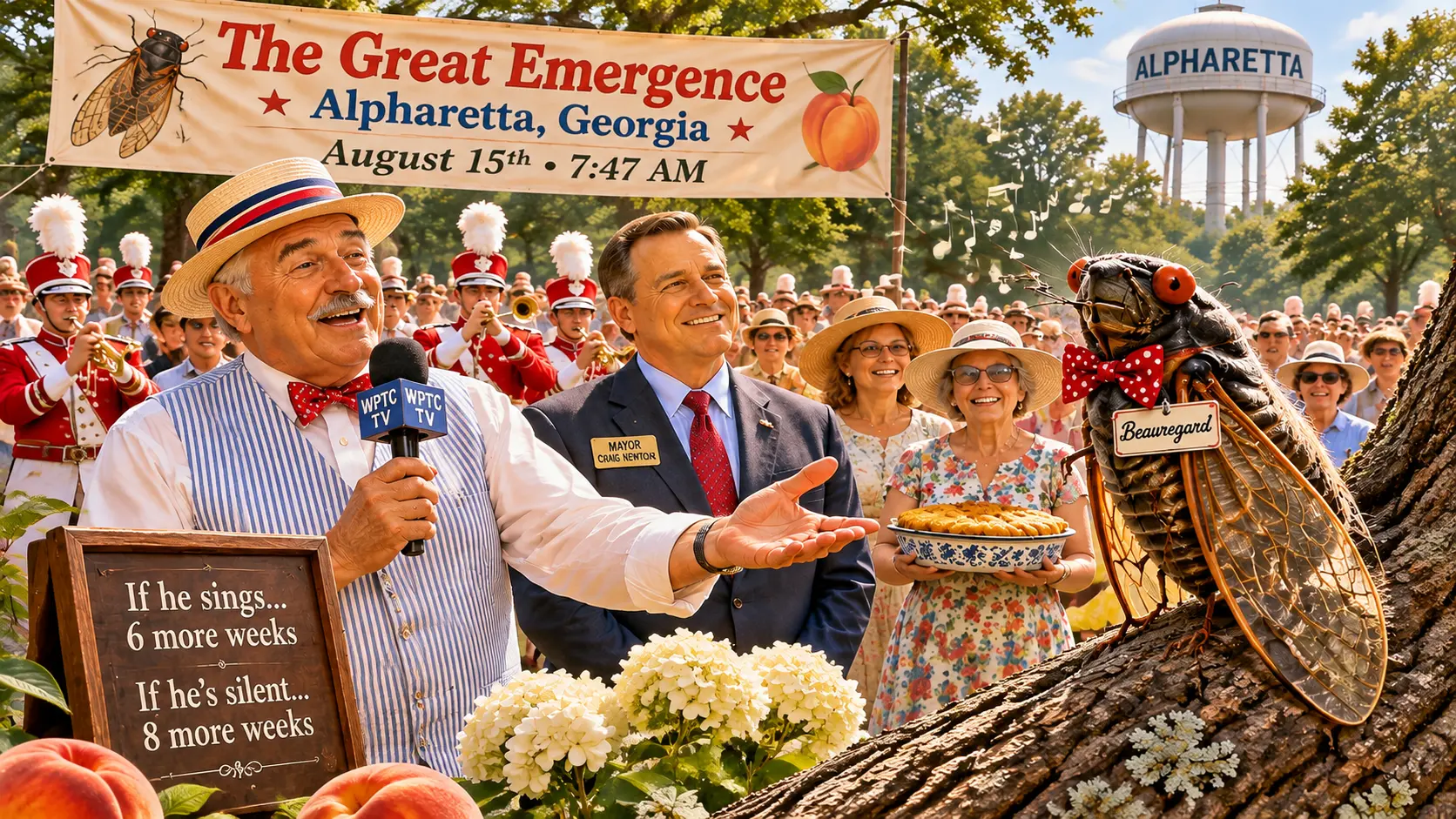
Every August 15th, as the sun beats down with the intensity of a Baptist preacher on judgment day, the good people of Alpharetta gather in Wills Park to witness what locals call “The Great Emergence.” Not to be confused with any sort of religious revival—though the fervor is comparable—this ceremony centers around one particular creature: Beauregard, a seventeen-year periodical cicada who has somehow managed to confuse his natural schedule.
The tradition began in 1987 when local weatherman Chuck Magnolia (né Charles Magnowski from Newark, but that’s neither here nor there) was desperately searching for a way to boost ratings during the dog days of summer. While most of his colleagues were content to stand in front of green screens pointing at heat indices that would make a salamander sweat, Chuck had grander ambitions.
“I was watching the Weather Channel,” Chuck recalls, adjusting his seersucker vest, “and I thought, ‘Why should Pennsylvania have all the fun?’ We needed our own prognosticating critter.”
The choice of cicada was inspired, if not entirely logical. Unlike groundhogs, which have the decency to emerge predictably, cicadas follow their own mysterious schedule. But Beauregard—named after the Confederate general, naturally—had developed the curious habit of emerging from his underground lair precisely on August 15th, regardless of what his cicada calendar might suggest.
The ceremony itself is a marvel of Southern pageantry. At precisely 7:47 a.m. (the exact time is crucial, locals insist), Mayor Craig Newton approaches the ancient oak tree where Beauregard makes his annual appearance. He’s accompanied by the Alpharetta High School marching band, the local DAR chapter, and at least three women in floral print dresses who inevitably bring homemade peach cobbler.
If Beauregard emerges and immediately begins his distinctive seventeenth-year song—a sound with the romance of a rusty gate and the musical sophistication of a leaf blower—tradition holds that summer will last exactly six more weeks. However, if he emerges and remains silent, consulting what locals swear is his tiny weather station, then eight more weeks of sweltering heat await.
“It’s never failed us yet,” declares Mabel Honeysuckle, president of the Alpharetta Historical Society and keeper of the official Beauregard records. “‘Course, we’ve only been doing it for thirty-nine years, and cicadas ain’t exactly known for their conversational skills, but the man on TV says it’s science.”
The ceremony draws visitors from as far away as Peachtree Corners and Duluth, though skeptics might point out that Georgia summers last roughly the same length regardless of what any insect might predict. Such cynicism, however, misses the point entirely. Though satellites and supercomputers can now predict the weather, there’s something wonderfully ridiculous about entrusting your seasonal fate to a bug with the attention span of a mayfly and the musical talent of a broken air conditioner.
Chuck Magnolia, now in his seventies but still sporting the seersucker vest that has become his trademark, continues to broadcast the ceremony live on WPTC-TV. His ratings peak every August 15th, proving that sometimes the silliest traditions are the ones that stick.
“People ask me if I really believe Beauregard can predict the weather,” Chuck muses, mopping his brow with a monogrammed handkerchief. “I tell them, ‘Son, I’ve been wrong about the weather for forty years, and I’ve got a meteorology degree. What’s wrong with letting the cicada have a turn?’”
As for Beauregard himself, he remains blissfully unaware of his celebrity status, emerging each year with the reliability of a Swiss watch and the enthusiasm of a creature who spends most of his life underground. Whether his predictions are accurate is a matter of some debate, but his dedication to the role is unquestionable.
The tradition shows no signs of waning. Each year, the crowd grows larger, the ceremony more elaborate, and the peach cobbler more plentiful. In a state where college football is religion and sweet tea is a sacrament, the Great Emergence has earned its place in the pantheon of beloved Southern eccentricities.
After all, when everything else moves at the speed of the internet, there’s something to be said for a tradition that asks you to slow down, gather with your neighbors, and place your faith in the wisdom of an insect who has been doing his job longer than most of us have been alive.
Whether Beauregard’s predictions are meteorologically sound is beside the point. In Alpharetta, August 15th isn’t just about the weather—it’s about community, tradition, and the quiet comfort that comes from knowing that some things, no matter how absurd, will always remain exactly the same.
Note: Visitors planning to attend the Great Emergence are advised to bring folding chairs, sunscreen, and a healthy sense of humor. The ceremony typically lasts forty-five minutes, though this can vary depending on Beauregard’s mood and the ambient temperature.